Saturday, June 25, 2016

I've always put my hand up for challenges: Anil Kumble

Anil Kumble, the former India captain, who was appointed as head coach of the Indian cricket team on Thursday (June 23), said it was 'a great honour' to take up the role and mentioned that he was eager to be back in the Indian dressing room, albeit in a different capacity.
Speaking after his appointment, the leading wicket-taker for India in Tests and One-Day Internationals (ODIs) said: "It's a great honour, to be back in the Indian dressing room, in a different role, in a different capacity, and I'd like to thank BCCI for showing faith in me and the cricket advisory committee (CAC) for showing faith in me.
"It's a huge responsibility, like I mentioned, but I've always put my hand up for challenges and I'm ready to take up this role. Coach's role, in my opinion, is always done in the background, players come first and that will be my approach. It's always the players first and the coaches come later," he added.
When asked if he has any strategies on taking Indian cricket forward, the 45-year-old said it's still early days but mentioned that he did have some plans in place and was eager to discuss them with the likes of Sachin Tendulkar, Sourav Ganguly, VVS Laxman and Rahul Dravid as well as the stakeholders of Indian cricket and the current players.
"It's a bit too early for me to speak on all of that. Yes, there is a certain plan, obviously, and the immediate series that is coming up is the West Indies. Obviously the strategy is to win. I haven't really spoken to the players yet, this is just the first reaction. There's time to think about that, sit with the players and work out how to go about it.
"It's a great thing for Indian cricket (the CAC). Sourav [Ganguly], Sachin [Tendulkar] and [VVS] Laxman, the three of them have been in advisory roles. Sourav, of course, is in an administrative role as well. And then Rahul [Dravid] is in charge of the junior team. The five of us have had a wonderful relationship on the field, and off it as well. And I think all five of us will have to sit down and do what is needed for the best interests of Indian cricket. Of course, stakeholders as far as cricket is concerned will also come in. I'm certainly looking forward to working with all of them," he said.
Appointed as head coach for a period of 12 months, Kumble's first assignment will be the tour of West Indies, where India will play four Tests. The former legspinner will also have an important role to play during India's 2016-17 home season, that will feature as many as 13 Test matches apart from eight ODIs and three Twenty20 Internationals.
"The plans are there. There is a short-term plan and long one as well. I have plans for the series ahead. But I cannot plan alone, I have to share my thoughts with the entire team. The players will also share their ideas. I'll also sit discuss with the CAC, Dravid and stake holders of Indian cricket on how to take the Indian team forward," said Kumble, who took over the role that was vacant since Duncan Fletcher's tenure came to an end after the 2015 Cricket World Cup.
Kumble admitted that the coach's job will not be an easy one, considering all the travel and the time away from family, and he thanked his family for being supportive when he first decided to apply for the job.
"I'm really honoured. I certainly felt this was the time for me to give back (to the game). I spoke about it with my family as well, it's not easy travelling 365 days. It's tough on the family, we had a long chat and they've been very supportive. It's not easy to travel again, I've been on that for 18 years. So that was the major decision and once that came about I thought this was the right time to give back," he said.
On the conflict of interest issue, that arises with Kumble owning a player-management firm, the former India skipper said it will be resolved before he officially assumes his role with the Indian team. "We have already discussed that and whatever needs to be done will be done before I take up this role officially. That's been discussed and it's clear with the BCCI as well, it's something that can be resolved," Kumble said.

Ireland to make Lord's debut in 2017

Ireland are set to make their maiden One-Day International (ODI) appearance at Lord's when they take on England on May 7, 2017, the England and Wales Cricket Board (ECB) declared on Thursday (June 23).
The encounter will be the second of the two-match ODI series between the countries, with the first scheduled to be played at Brightside Ground in Bristol on May 5.
England and Ireland have faced off seven times in the format with only one bilateral series that the two have engaged in, played in Ireland in 2015. The more renowned of their encounters was the ICC World Cup 2011 clash where Kevin O'Brien belted a 50-ball century to help Ireland chase down 327 in Bangalore and stun their neighbours.
Ireland recently lost a two-match ODI series to Sri Lanka at home before the tourists kick-started the five-match ODI series against England - the first of which, ended in a tie.
Ireland's next assignment is a five-match ODI series against Afghanistan, which is set to begin on July 10.

Anil Kumble appointed head coach of India

Legendary spinner Anil Kumble has been appointed the new head coach of the Indian cricket team for a period of 12 months, the Board of Control for Cricket in India (BCCI) announced on Thursday (June 23) at the board's inaugural cricket conclave in Dharamsala. The 45-year-old former legspinner fended off competition from 56 other applicants, including Ravi Shastri, India's former team director, to the top post.
After Duncan Fletcher's contract had expired following the ICC World Cup in 2015, the post of head coach was left vacant with Shastri being appointed team director for subsequent tours. Kumble takes over the side from Shastri, whose contract expired after the World Twenty20.
Kumble's name for the role was put forth by the three-member advisory committee comprising of Sachin Tendulkar, Sourav Ganguly and VVS Laxman, headed by Sanjay Jagdale, the former BCCI secretary, who interviewed the shortlisted applicants about their goals and ambition for the future of Indian cricket. Kumble's presentation on taking Indian cricket forward and potential steps to achieve top ranking in every format is said to have been the clincher in his appointment.
"He (Kumble) has been a match winner of India," board president Anurag Thakur said during the announcement. "It was not about Indian or foreign coach. It was about who is the best for Indian cricket. We have kept it very transparent. Their presentations... how they can take Indian cricket forward. We have the largest cricket fans in the world. We have the strongest economies. I think Indian cricket deserves the best and we have Kumble with us. His record speaks for himself, as far as winning matches for India is concerned. "
Despite not meeting two important criteria set for the aspirants - not having any previous coaching experience at first-class or international level and not being a certified coach - Kumble brings with him a wealth of international experience, having featured in 132 Tests and 271 One-Day Internationals (ODIs) during an illustrious career than spanned 18 years. He has also served as a mentor for Indian Premier League franchises Royal Challengers Bangalore and Mumbai Indians besides serving in administrative roles as the president of the Karnataka State Cricket Association (KSCA) and the chairman of the National Cricket Academy (NCA).
Thakur confirmed that the composition of the support staff, including the batting, bowling and the fielding coaches will be revealed later. BCCI secretary, Ajay Shirke also ensured that Kumble's appointment will lead to no conflict of interest repercussions pertaining to his role with 'TenVic' - Kumble's player management firm that manages the interests of several Karnataka players among others.
"Conflict of interest has become a fashionable word. All the concerns regarding that have been addressed. There will be no conflict of interest when he takes over," Shirke said.
Kumble's first assignment will be India's four-Test tour of West Indies, starting July 21. He will join the team at the pre-tour camp at the NCA, starting June 29.

Champions Trophy likely to be scrapped after 2021

The International Cricket Council (ICC) is contemplating scrapping the Champions Trophy after the 2021 edition, according to reports on ESPNcricinfo. The tournament was set to be abolished in 2013, but following its success, it was decided to stage another edition in 2017 in England instead of the inaugural World Test Championship.
If the new One-Day International (ODI) League does crop up from 2019, next year's tournament in England could be the last time we see teams fighting it out for what is usually termed as the 'mini World Cup'. The league could see 13 teams playing each other over a period of three years with the top teams clashing in a play-off in 2022.
Since the ICC is not in favour of having three competitions for the 50-over format, the 2021 edition in India might not take place. In such a scenario, India might get to host the 2022 or the 2024 World Twenty20 since the recommendation to stage the competition every two years once is likely to be approved at the ICC Annual Conference in Edinburgh. And hence the ICC will not look at the potential commercial loss by scrapping a tournament which was quite popular last time.
The Champions Trophy is usually played across three weeks and consists of 15 matches. Next year's edition will see Bangladesh playing in the tournament at the expense of West Indies. India are the defending champions after they beat hosts England in the final in 2013. India also won it back in 2002 when they shared the trophy with Sri Lanka. Australia have also won it twice, winning it in 2006 and then becoming the first team to retain it successfully in 2009.

Thursday, June 23, 2016

Minhajul Abedin appointed Bangladesh chief selector

Minhajul Abedin as the new chief selector two days after Faruque Ahmed announced his resignation from the post. Abedin has been a selector since 2011. Habibul Bashar, who was to take care of women's selection, has been brought back to his old position as selector for the men's senior team.
The BCB appointed
"We have appointed Minhajul Abedin as the chief selector," BCB president Nazmul Hassan said. "We have also brought back Habibul Bashar to this panel after we had asked him to be the women's selector, because we have lost Faruque."
At a board meeting on Sunday, the BCB expanded the selection panel to also include include head coach Chandika Hathurusingha, team manager Khaled Mahmud and cricket operations chairman Akram Khan.
Faruque had been named chief selector, but stepped down hours after the announcement saying the new system wouldn't help Bangladesh cricket. He felt involvement of board members in the selection process would be too much of an interference.
BCB chief Nazmul Hassan defended the change saying, "there wasn't a single time that I didn't have to interfere with the team Faruque submitted to me. We had to sit with them every time. So I have created this new system so that I have minimum interference in selection."
Abedin was happy to take on the mantle of chief selector. He was considered one of Bangladesh's best batsmen prior to their achieving Test status in 2000. He has played 27 ODIs as well and led the team in the 1990 Asia Cup.
"If there were any interferences we wouldn't be able to work in the last five years," Abedin said. "I think it is better not to think about these things and try to take Bangladesh cricket forward. I think the new system is more like what we have been doing previously where we have to approve the team from the cricket operations chairman and then to the board president."

Mahmud conduit between players and coach - Hassan

Nazmul Hassan has said the decision to include Bangladesh team manager Khaled Mahmud in the selection committee was a result of lack of communication between the players and coach Chandika Hathurusingha. In a heated press conference in Mirpur on Wednesday, Hassan said he was tired of explaining why he changed the selection structure from a three-member to a six-member committee.
BCB president
Explaining the reason behind the manager's inclusion, Hassan mentioned an incident during the World T20, when he attended a team meeting and found the Bangladesh players not challenging Hathurusingha. He said the players often used Mahmud as their envoy to push for suggestions regarding team selection but they were not approaching Hathurusingha directly.
Hassan said Mahmud, after informing him of these suggestions, would relay the message to Hathurusingha. To relieve himself of getting too involved in selection matters, Hassan has included Mahmud in the selection committee, where he will act as the captains' representative.
"I have to explain this out of disappointment," Hassan said. "You know that I am very much involved with the players. During the World Cup and the World T20, I attended the team meetings. I saw there that the coach gives a strategic plan for every aspect of the match, in a lot of detail.
"Unfortunately, I saw that our players didn't challenge the coach but when I got out of their meeting room, couple of the players walked out with me. They told me that there has to be some changes made, mainly about selection. I asked them, 'Why didn't you tell him in the meeting?' But they don't get into any argument with the coach, whether it is the captain or the other players.
"When I don't attend these meetings, they communicate via the manager Sujon [Mahmud], who conveys it to me and I have to tell the coach. I don't want to be involved in these things. So I thought that I should have lesser involvement in these matters. We can't run things in this way so this is why I have included the manager in the selection committee. The only person who could have a problem with the manager in this committee is the captain. But he is fine with it, so why does the selector have a problem with it?"
It is extremely rare for a BCB president to reveal such details from within the Bangladesh dressing room. Hathurusingha has been hailed as instrumental to the team's successes in 2015, with many players suggesting he has given them freedom to express themselves in every match situation.
While Hathurusingha has had public fallings-out with the chief selector Faruque Ahmed and former cricket operations chairman Naimur Rahman, he has never publicly criticised any Bangladesh player. Nor has any player spoken of communication difficulties with Hathurusingha.
When contacted, a number of Bangladesh players refused to comment on the board president taking about the team's private matters. Hassan admitted he wasn't supposed to reveal such information in a press conference but he succumbed to the continuous questioning about Mahmud's inclusion in the revamped selection committee.
"Is it a good thing that I just said that our captains and players are scared of the coach?" Hassan said. "This news will now spread around the world but you won't leave me alone until I say all these things."

Six appeal marks brave new era for focussed England

Over the next month, expectations will be tempered through the usual stutters that cricket serves up to keep its incumbents in check. But, for today at least, England's women were flawless in their execution of an attacking approach that looks to be moving away from PowerPoint presentations and straight into their veins. Today, new era meant new records.
Their total of 378 for 5 was the third highest score they have managed in ODI cricket and the fourth-highest for any team. No England team had scored more sixes in an ODI (11 today), while not one England player had hit more than one six in their innings before three did so here. Lauren Winfield and Tammy Beaumont registered maiden ODI hundreds and, in the process, scored 235 to set a new record for the highest opening stand in the format. Their partnership was also the sixth-highest for any ODI wicket. No team, male or female, has scored more in 50 overs at New Road.
Winfield and Beaumont showed their intent from the start, sent in to bat after Pakistan won the toss. The first ODI was the first time they had opened together at the highest level, despite spending their undergraduate years defacing the record books at Loughborough University. Where previously they took turns stating their case for the same England spot with the other watching on, here for 231 deliveries, they united to dispel past frustrations.

Beaumont had shed some baggage at the World T20, and it showed: the post-boundary swaggers might well have been set to music. Winfield, however, has had to wait until now for that moment. Her 32 internationals before today had reaped just one half-century.
For a punchy, straight-shooting individual, a timidity had crept into her game. Head coach Mark Robinson was almost bemused by her poor record after seeing her at close quarters.
When she failed to make the World T20 squad, Robinson took her to one side: "Somehow, we have to get you in this team," he told her. Winfield's beaming smile at the end was only matched by Robinson's.
There was an element of ruthlessness to the approach of both openers. Perhaps the moment that typified the callousness of the opening assault was the muted tip of the helmet from Winfield as she brought up three figures. There was nothing in her reaction to suggest this was her first international hundred, or that she was carrying a diamond duck from the first ODI in her back pocket.
The pair were watchful for the first six overs, scoring 19 while assessing the pitch and sharing notes. Satisfied, they brought up England's century just 10 overs later. Greeted with a lack of pace off the pitch, as Pakistan cycled through their bowling options to frustrate, they did not resort to swinging across the line. Instead, they waited: Beaumont in particular used her wrists to dollop an extra serving on her shots through cover, while maintaining a strong base.
Going stroke for stroke, it was Winfield who won the race to 100, off 106 balls. Beaumont followed 11 deliveries later, taking a slightly risky single to cover off her 114th ball that had her cursing from the start then dusty and elated as she dived for the crease before raising her arms to salute the crowd and embrace her opening partner.
While the manner in which the runs were scored spoke of freedom, everything around them reeked focus. During the World T20, England's first six of the competition, against Bangladesh in Bangalore, was cheered raucously by the dug-out. In their final group match in Chennai, against Pakistan, Charlotte Edwards punched the air sarcastically after stepping across her stumps and lapping over her shoulder - a shot she had been honing in the build-up to the tournament and subsequently pulled off perfectly.
Perhaps another time twin tons and breaching 300 in such devastating fashion would have broken out the bunting. Instead, the assault kept going as Nat Sciver walked in to lead the heist of 132 from the last 10 overs.
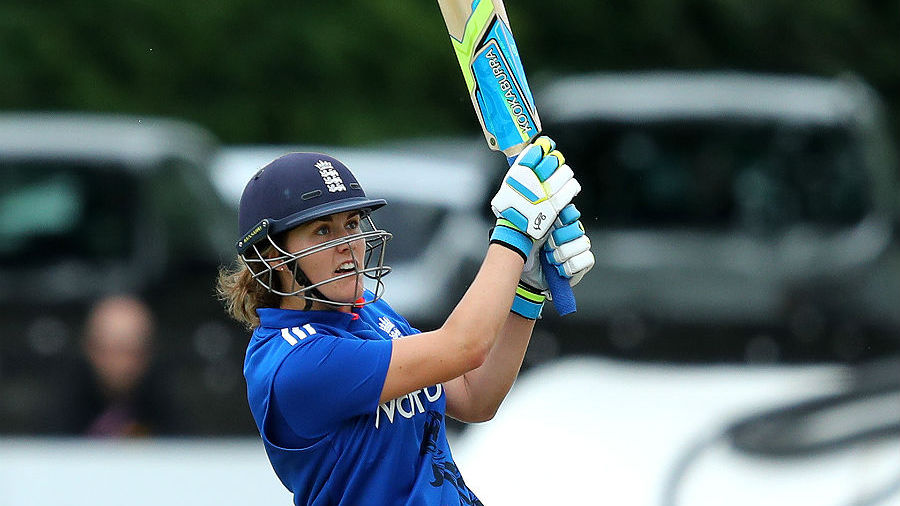
The numbers tell Sciver's story: 80 off 33 balls, 22 for the fifty (the fastest recorded in women's ODIs) and seven sixes. Most were down the ground, but her second, off Nina Dar, was obscene: a slog sweep taken on the up which threatened Worcester Cathedral at midwicket. Sciver, like most of this England team, struggles to talk herself up. With striking like that, she can let the stats do the singing.
Without wishing to be the one that brings warm milk to the house party, England did benefit from 55-yard boundaries and a woeful effort in the field from Pakistan. In the estimation of Sana Mir, Pakistan's captain, this was a chastening performance that needs to be learned from rather than forgotten.
Three changes were made from the side that lost the opening rubber at Grace Road, most notably Anam Amin, one of the world's top left-arm spinners, who sat out this match after sustaining a hand injury in that match. Without her, there was no threat in the middle overs: no fear of either of these right-handers being done on the outside edge. Pace bowler Maham Tariq arrived in the UK yesterday and was drafted in to take the second over.
That the 235 opening stand was the highest partnership for any wicket in the last seven years - a period in which the women's international game has improved exponentially - speaks volumes. Mismatches like this are harder to come by nowadays. Pakistan were never a part of this contest. If this were a boxing match, they would have had to pay at the door.
What limited resistance they offered came from the bat of Bismah Maroof, as they fell 212 short chasing a target they were never going to reach, in the midst of an opposition fielding effort that was never going to reciprocate their generosity.
Vice-captain Anya Shrubsole and Katherine Brunt dovetailed with 4 for 19 and 2 for 27 respectively. Sciver nabbed two herself, while Danni Wyatt marked her territory at backward point with direct-hit run outs of Nahida Khan and Mir. Maroof managed a tenth ODI fifty, but when she caved, that was that.
To step back from this match, England needed a performance to justify high-profile turnovers and Robinson's faith in youth. As far as statements go, this was emphatic.